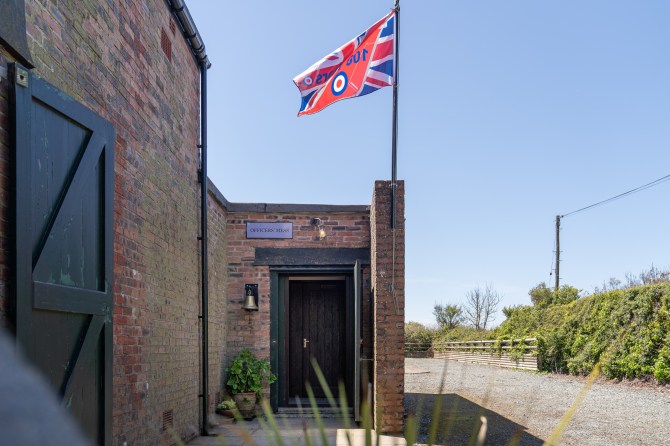
The Radar Rooms, progress on repairs and maintenance 2024

This progress post will be updated annually. In the meantime, its aim is to give our followers an understanding as to the reasons for changing our Flight Plan in 2021. The intention was to create enough revenue to cover the never-ending running costs, repairs and maintenance by modifying the existing accommodation to be more suitable for paying guests. The additional revenue is being well spent on heating the room spaces and thus preserving both our heritage site and our treasured GaVa aviation art collection, along with supporting our ongoing maintenance costs.

Recent progress has been focused on roof repairs and the rendering of an external wall to the Set House, (former Generator House). We had endured much dampness in parts of the building due to a failed roof and an external wall with no cavity. In the spring of 2023 Leeks of Crosshands replaced the failed roof, generously at cost price. However, at cost price the sum was still in excess of £9000 plus waterproof rendering costs of approximately £1000 for the external wall in 2024. Nevertheless, we never regret our decision to save our amazing heritage site

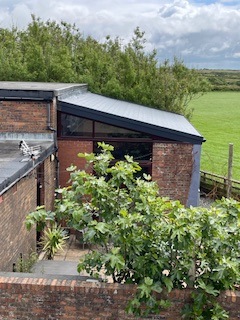
Further roof repairs are required for the Admin Wing so as to stop the considerable minor leakage at bay. This workscope will be undertaken this summer by myself with family assistance of local labour, estimated materials cost £10,000.

Finally on roof repairs, the northern roof edge of the Ops Room requires urgent repair so as to stop major leakage.


The main Operations Hall was split into two halves during our early days of the “Repair & Maintenance Project”. The eastern end which has access via the Admin Wing has been undergoing a recreation of the Ops Room on a smaller scale plus attempting to model one of the Fighter Control Rooms. Heritage tours and presentations are conducted within this room.

Courtesy of Mike Dean

Internally we have cleared the western half of the ops hall of all the abandoned goods left there by the previous occupier The hall now requires a final clean/sweep and a decision on what to do with the space. We have an idea to create a mock Ops Hall facade onto the dividing wall but in the meantime are concentrating getting all the buildings up to spec weather proof wise and also on extending the existing ‘radar operations room’ utilising the WWII items that have been donated to us.

Original Image of Operations Hall looking back to the upper 3 control cabins

Courtesy of Mike Dean

Current image showing dividing wall with potential for façade to imitate original image.
Image showing cleared Ops Hall with original war time paint which we intend to preserve.

Thank you for being a part of our journey – we appreciate all your excellent support and your interest in what we are doing here at former RAF Ripperston.

Until next time – Good Luck & God Speed

All Our Yesterdays – D-Day

The Royal Air Force at Omaha Beach

RAF GCI 15082 Radar Convoy Vehicles Destroyed at Omaha Beach
Photographic Credit – US National Archives

Why was there a small contingent of RAF Technical personnel mixed up with over 130,000 highly trained combat troops attempting to land on Normandy beaches on D-Day?

Spare a thought this evening of the 5th June 2024 that 80 years ago, 7000 ships and landing craft manned by 195,000 naval personnel from 8 allied countries. Almost 133,000 troops from the USA, British Empire & their allies: were on the eve of what was to be the largest seaborne invasion in history, 6th June 1944. This historic date was to be the most momentous happening in modern history and was the beginning of the liberation of Europe from the tyranny of Nazi Germany.

Planning for the allied invasion of Europe finally got underway in May 1943 during an Anglo – American conference in Washington. Consideration was given to the opening of a front in Western Europe for offensive operations against German occupation. The planners selected 50 miles of coast in western Normandy. Five beaches were selected as invasion sites Juno, Gold, Utah, Sword & Omaha.

As detailed planning progressed it was strongly recommended to get Radar coverage for the Landing Beaches and once landing progressed to get further Radar units set up in Normandy, all of which were to provide vital protection from the Luftwaffe during the amphibious landings on exposed beaches.

Radar protection for the beaches was established by the conversion of 3 Landing Ships Tank (LST) into air surveillance & control ships designated as Fighter Direction Tenders (FDT); crewed by RAF technical personnel with the Navy providing the marine crew. The 3 FDTs were positioned & anchored at strategic locations off the Normandy coast & provided outstanding air coverage.

FTD 217

The following link provides an excellent Briefing Paper by the Association of RAF Fighter Control Officers. The D-Day Fighter Control Story, compiled & edited by Group Captain Tim Willbond RAF (Retd)

D-Day Fighter Control Story

Further Radar protection was planned to be established inland of the Normandy landing beaches to provide air coverage further into Normandy as the allies progressed. To achieve this objective, RAF personnel were selected to form Mobile Radar Units & extensive training began from mid 1943 in Scotland which included practice landings from landing craft which operationally was usually associated with “front line infantry”. See the following link

https://www.therafatomahabeach.com/precis/

Further recommended reading on mobile GCI radar units is covered in a very informative book, Off to War with “054”, by Sqd Ldr John Kemp who was the second CO of GCI RAF Ripperston (the radar rooms)

The Radar Rooms – 2nd Post

Ripperston Flight Plan

Honour our Past

Embrace our Present

Inspire our Future

This Blog will follow a number of varying themes.         

* 2024 Anniversaries

– D-Day 80th Anniversary 6th June 2024 highlighting the importance the RAF   Radar Units played on that Historic Day

– Operation Market Garden Anniversary 17th September 2024, describing the role of Airborne RAF Radar Units.

* Progress with restoration of The Radar Rooms

* History in the creation of GCI Ripperston in 1941; how in developed &      performed from 1941-1945 as a series of (All Our Yesterdays).

* Articles about our private aviation art collection, the GAvA artists & their work.

* Articles about our journeys & travels to heritage & RAF locations.

* Summary of Events 2018 – 2024

* November 2018 celebration of RAF 100, 60 attendees

* November 2018 – March 2020 twice weekly heritage presentation for visitors to St Brides Castle HPB, autumn through to spring.

* March 2020 lock-down

* Unable to re-open after restrictions were lifted due to our being unable to comply with social distancing requirements.

* January – May 2021 still unable to open due to social distancing; up-keep, heating & maintenance costs were still mounting up.

* June 2021 decision made to alter Project Flight Plan to include paid accommodation so as to be able to generate much needed revenue to support the Project. Our priority as always to keep the WW2 History & heritage side of GCI Radar Station RAF Ripperston very much alive.

The Radar Rooms 1st Post

A protected entrance to an historic place

I had intended to start this Blog during July 2021 which would have been the 80th anniversary for the opening of RAF (GCI) Ripperston and thereafter would have added a monthly update of activities, “All Our Yesterdays”, as they happened 80 years ago from my comprehensive records of RAF Ripperston. However, events took a turn, which along with the Covid lock downs had left us unable to reopen the heritage site due to social distancing requirements which were unachievable due to the narrow corridors within the buildings. Furthermore, with no revenue coming in we still had to fund the upkeep, constant repairs and heating costs, from our savings. In May/June 2021 we renamed the Project to “The Radar Rooms” and made the decision to adapt the existing accommodation into two self contained facilities and the remaining space into an Art Centre for workshops. This required considerable work & time to set up successfully.

We are now into our fourth year of successful bookings along with giving many families the experience of staying in unique 1940s atmospheric accommodation and with gaining a historic insight into how the RAF operated GCI Radar Stations. This valuable additional revenue has provided funding to continue with repairs, maintenance and to help with the huge energy costs.

To see our 1940’s accommodation go to the Officers’ Mess and the Officers’ Quarters.

Welcome to The Radar Rooms

So what is this all about. So, you may have read already about The Radar Rooms, the Officers’ Mess & the Officers’ Quarters but unless you have read our History of Works page then you will have no idea of how this all came about.

The former GCI Radar station, RAF Ripperston, came with our house. How glib is that – well, yes, but it is the truth and we just did not know what it was.

  • On a wet & windy day, a few years after we had moved here, the front door bell rang and a very quiet, unassuming gentleman, asked if he could view our RAF buildings. He told us they were a ‘Top Secret’ Radar Station during WWII. His very smart suit became rather less smart as he wondered around the dirty, leaking and dilapidated buildings, fascinating us with his wonderful knowledge. At the time of the previous owner just a couple of years previous, the buildings were used as a Pig Farm & Kennels.
  • John’s fascination grew and as time passed he began to do more research into the buildings origin & history. We started a gradual repair programme – see History of Repairs
  • In 2015, following a four page spread in Pembrokeshire Life, we opened to the public for three months, with a Heritage Presentation/Guided Tour and a prestigious Art Exhibition by 56 Group Wales. Since then we have had many visitors. We have promoted the art of selected top Welsh Art Graduates along with stunning paintings by GAvA – Guild of Aviation artists. Always by appointment as the buildings are a very well used and loved part of our home, but always there for visitors to share this fascinating part of our history.
  • We continued to use the buildings ourselves as a fully integrated part of our home, for our hobbies, for the promotion of Welsh artists and for guided tours (which included John’s brilliant Radar presentation). We had visitors staying from all over the country, one from as far away as the USA, whose father was stationed here. RAF personnel, individuals with links to WWII radar and visiting artists all enjoyed the 1940’s atmosphere of the station and we were just about able to cover the costs of heating and maintenance from the generous donations we received.
  • Then came COVID. And somehow we had to save this amazing part of our history from returning to its former dilapidated state.

Our next post tells of how, by sharing our Radar Rooms as a 1940’s retreat, we are managing to do this.

Thank you very much for your interest.